Tracking Satellites from a South LA Rooftop: A Low Earth Orbit Primer
Here's a secret hiding in plain sight: the space age flies over your house every night. Thousands of satellites in low Earth orbit — including the International Space Station — pass above Los Angeles daily, visible to the naked eye if you know when to look up. No telescope required. No permission needed.
What Is Low Earth Orbit, Anyway?
Low Earth orbit (LEO) is the band of space from roughly 100 to 1,200 miles up. It's where the ISS lives, where most imaging and internet satellites operate, and where objects move so fast they circle the entire planet in about 90 minutes. That means the astronauts overhead see a sunrise every hour and a half — and it means a satellite that passes over Compton tonight will pass over again before bedtime.
When you spot one, you're not seeing lights on the spacecraft. You're seeing sunlight glinting off its panels while you stand in the dark. A mirror, 250 miles up, moving at 17,500 miles per hour.
The Rooftop Setup
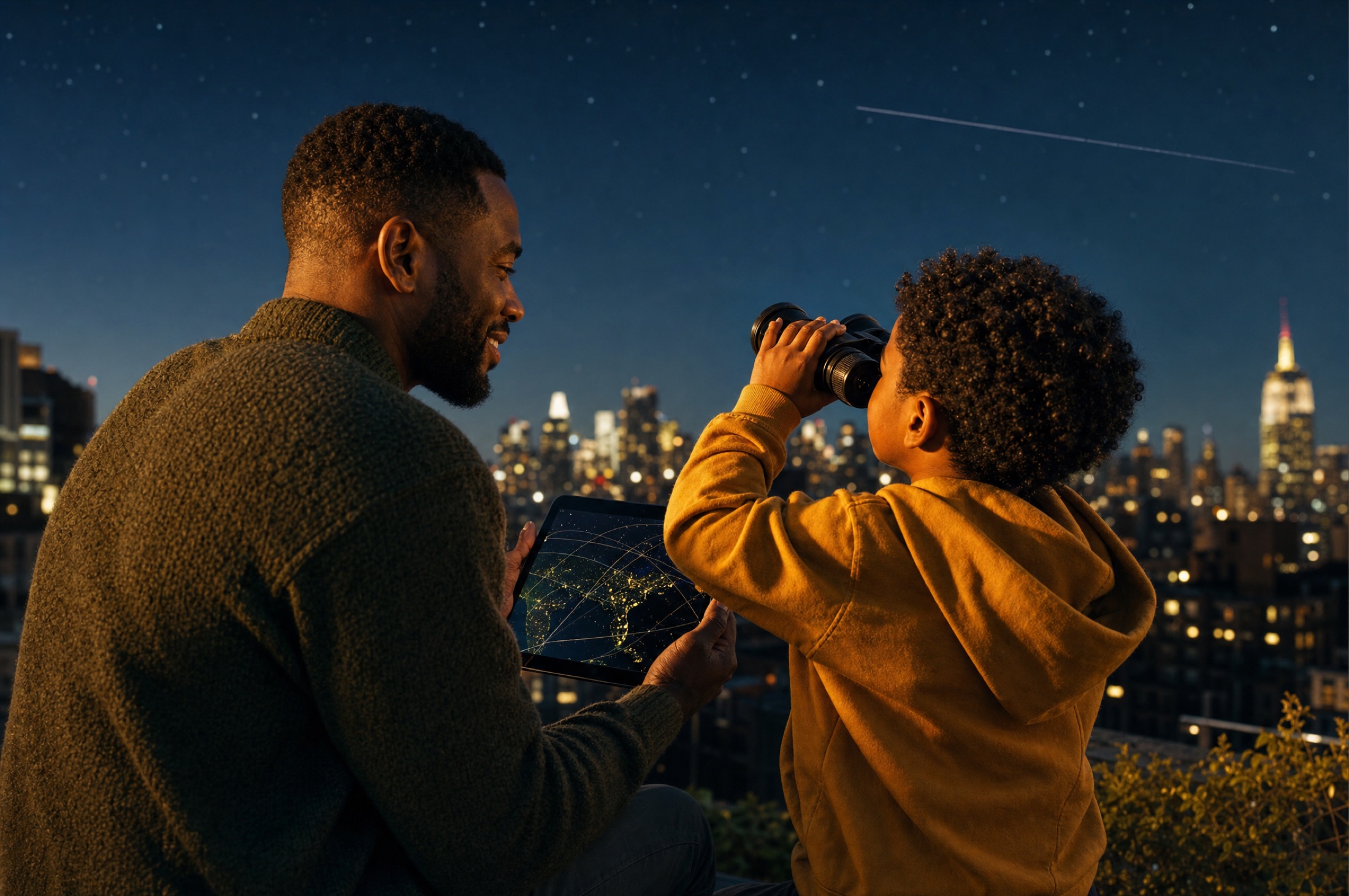
At our Night Sky Nights, the gear list is short: a free satellite-tracking app, a clear patch of sky, and patience measured in minutes, not hours. The app tells you exactly when the ISS will rise, which direction to face, and how bright it'll be. Then the countdown starts — and when that steady golden dot slides across the sky right on schedule, on a path a kid predicted from a phone in their hand, something clicks.
Because that's the real lesson: this is *predictable*. It's math. And the kid who just predicted it did the same fundamental thing aerospace engineers do in El Segundo, twenty minutes from here, for a living.
From Looking Up to Building Up
The space economy is hiring — engineers, technicians, coders, machinists — and much of it is headquartered right here in Southern California. Our Future Builders programs use satellite tracking as a doorway into orbital mechanics, radio, and data skills, and our Making Moments events turn it into family ritual.
Come look up with us. Check upcoming events for the next Night Sky Night — the ISS will be right on time.
Tags: